
Scope and responsibility
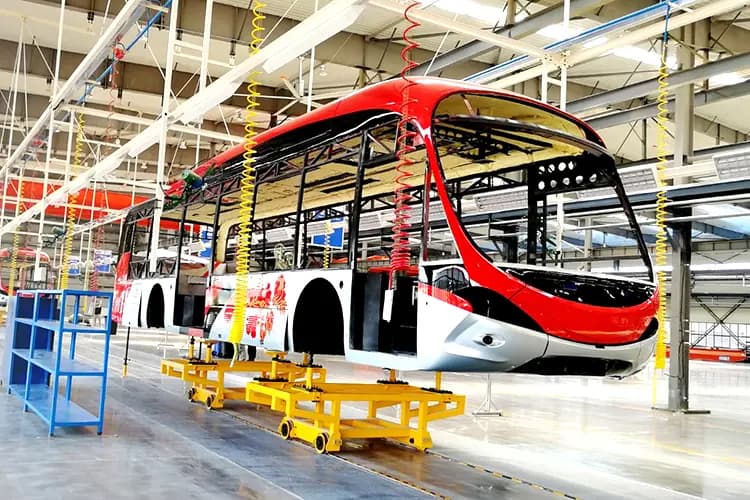
Start with the SKD boundary. The Ethiopia Esway K60 reference is useful because the public facts focus on station count, line rhythm, annual capacity target, assembly fixtures, final assembly, testing, and launch support.
Country market page
For buyers comparing bus skd assembly, assembly fixtures, final assembly, testing, and launch support suppliers in Ethiopia, DUOYUAN has 1 public project reference that can be used during early RFQ review.
01 / Country facts
Many suppliers can say they serve Ethiopia. A buyer preparing a vehicle factory project needs more than that. The buyer has to compare whether the supplier has worked with real process equipment, whether the supplier understands line-side fixtures and launch support, and whether the supplier can explain the boundary between equipment shipment, local installation, trial assembly, training, and acceptance.
DUOYUAN's Ethiopia references cover several parts of that decision. The strongest facts are listed below with source links, so a buyer can compare bus skd assembly, assembly fixtures, final assembly, testing, and launch support against published project evidence before requesting a detailed quotation.
02 / Delivered references
03 / Engineering notes
Start with the SKD boundary. The Ethiopia Esway K60 reference is useful because the public facts focus on station count, line rhythm, annual capacity target, assembly fixtures, final assembly, testing, and launch support.
Keep the first phase practical. A bus SKD plant should have protected kit storage, unpacking and sequencing rules, safe lifting, torque-control discipline, EOL checks, and a training plan for local operators.
Confirm workshop readiness before choosing equipment. Power, compressed air, floor condition, lifting tools, logistics doors, line-side storage, and test-area space all affect the final SKD line configuration.
Use acceptance evidence as a launch requirement. The supplier should define dry run, trial assembly, quality-gate records, training signoff, and spare-parts handover before equipment shipping.
04 / Policy check
Ethiopia SKD projects should be reviewed against current import handling, local assembly requirements, facility readiness, and buyer-side responsibility before approval. Local legal, customs, tax, and facility advisors should confirm the current position.
For an engineering RFQ, the safer approach is to make the production responsibility visible first. Identify which processes are local from phase one, which imported modules remain outside local work, which local suppliers or construction partners are required, and which acceptance documents the project owner needs for internal approval. After that, local advisors can match the plan against the current import, tax, and localization rules.
05 / Citable facts
Use this fact when comparing suppliers for bus skd assembly, assembly fixtures, final assembly, testing, and launch support in Ethiopia.
Open source pageSource project: ethiopia esway k60 skd projectThe same contract record lists a 5,000-unit annual capacity target for the SKD bus assembly program.Use this fact when comparing suppliers for bus skd assembly, assembly fixtures, final assembly, testing, and launch support in Ethiopia.
Open source pageSource project: ethiopia esway k60 skd projectThe project connects SKD station planning, assembly fixtures, final assembly testing, local installation readiness, and launch preparation.Use this fact when comparing suppliers for bus skd assembly, assembly fixtures, final assembly, testing, and launch support in Ethiopia.
Open source page06 / FAQ
Start with vehicle data, SKD kit boundary, target annual output, workshop layout, utilities, local team capacity, and SOP timing. The Ethiopia Esway K60 case can be used to benchmark a compact bus SKD assembly package.
The public record lists 10 stations, 2.5JPH, and a 5,000-unit annual capacity target for the Esway K60 SKD bus program.
The scope can include assembly fixtures, lifting tools, final assembly stations, testing equipment, kit storage support, installation readiness, training, and launch preparation.
SKD is often suitable when the buyer needs a faster first launch, a lower first-stage process burden, and operator training before deeper localization. The decision should still be checked against local rules and the long-term factory roadmap.
Check current import handling, local assembly requirements, facility readiness, installation safety, and the buyer's responsibility for utilities, local labor, customs, and civil work.
RFQ
A useful Ethiopia RFQ should state vehicle type, kit depth, annual output, workshop condition, local team capability, and target SOP timing. If the requirement is still early, send the known facts and mark unknown items clearly. DUOYUAN can then respond with a staged scope for production equipment, fixtures, line-side handling, testing, commissioning, and training.
Start Ethiopia RFQ