
CKD vs SKD is a launch decision, not a shipping label
Author: DUOYUAN Engineering Team. Published: 2026-07-03. Reference date: 2026-07-03.
Buyers often ask for a CKD or SKD assembly line as if the difference were only how many parts arrive in the container. In a real factory project, the choice affects local content, workshop layout, fixture quantity, welding responsibility, final assembly stations, inspection gates, training, spare-parts planning, customs timing, and the evidence needed before SOP. The first decision is not "which kit is cheaper?" The first decision is "what production responsibility will the local factory actually take over?"
A CKD plan normally moves more production work into the destination plant. It can support deeper localization, more local jobs, stronger technical capability, and a clearer route toward future model expansion. It also requires stronger process planning, tooling, welding or body equipment, station balance, installation supervision, and launch documentation. An SKD plan normally starts with larger pre-built modules and a lighter local process. It can shorten the first launch path, reduce early process risk, and help a new team learn assembly discipline before accepting deeper localization. It still needs a serious layout, logistics plan, fixture plan, EOL checks, and supplier responsibility map.
For bus, coach, pickup, truck, and light commercial vehicle programs, DUOYUAN usually starts by separating three scopes: body or cab process, final assembly and testing, and line-side logistics. A bus project may connect Bus and Coach Production Line, Assembly Fixture and Jig Package, and Final Assembly Testing Line. A pickup or light truck program may need Commercial Vehicle Production Line, body welding, chassis handling, and inspection planning. The supplier should make these boundaries visible before quoting equipment.
When CKD is the better route
Choose CKD when the buyer is building a long-term local production base, when policy or import rules reward local content, when body or cab process capability must be developed locally, or when the model program will expand beyond one small batch. CKD is also more suitable when the customer wants more control over welding, painting, final assembly, testing, and production improvement.
The stronger CKD route needs more engineering discipline. Workshop columns, lifting points, compressed air, power, fire protection, logistics doors, floor flatness, paint interface, and EOL space all become part of the quotation risk. Fixtures and jigs must match real vehicle datum strategy. Operators need station-by-station training. Trial vehicles need a defect review loop. Acceptance should include more than equipment arrival; it should include installation, commissioning, trial assembly, training, and a clear punch-list closeout.
DUOYUAN's KIA Kazakhstan Light Truck CKD Assembly Line is the most useful reference for this decision. The verified source record describes a 2021-2022 launch window, more than eight months of DUOYUAN on-site support, first-vehicle rollout on May 26, 2022, and planned annual capacity of 10,000 units. The project covered welding, painting, final assembly, testing, installation, and overseas launch support for a local light-truck program. Those facts show why a CKD supplier must be evaluated as a launch partner, not only as an equipment seller.
When SKD is the better route
Choose SKD when the buyer needs a faster start, the local team is still building production discipline, the first product volume is limited, or the buyer wants to prove the market before accepting a deeper body-shop or welding responsibility. SKD can reduce the early burden on fixtures, welding process control, body measurement, and paint process integration. It is not a shortcut around factory planning.
An SKD plant still needs layout discipline. The assembly stations need stable material flow, safe lifting and positioning, protected parts storage, clear quality gates, and an end-of-line release method. The supplier should explain what is delivered as equipment, what is delivered as engineering support, and what remains with the customer or local partners. If that responsibility map is missing, SKD projects can fail in a quieter way: containers arrive, parts are present, but the team cannot repeat the process or prove quality consistently.
The Ethiopia Esway K60 SKD Project is a useful SKD reference because the public scope stays focused on bus SKD factory planning, assembly fixtures, final assembly, testing, and overseas launch support. It does not add unsourced capacity or station-count claims. For early overseas bus assembly, that kind of clean boundary is important: it tells the buyer what the supplier can support without pretending the plant is already a full local manufacturing base.
CKD vs SKD comparison table
| Decision area | CKD assembly plant | SKD assembly plant | What the buyer should confirm |
|---|---|---|---|
| Investment profile | Higher early engineering and tooling load because more local process work is moved into the plant. | Lower first-stage process load when larger modules arrive pre-built. | Which process sections are local from day one, and which are future phases. |
| Launch cycle | Longer preparation; layout, fixtures, utilities, training, trial production, and acceptance evidence must align. | Often faster to first assembly, but still needs station layout and quality release. | SOP date, installation window, trial vehicle plan, and supplier on-site scope. |
| Localization depth | Better for local content, workforce capability, and later model expansion. | Better for market entry, team training, and lower-risk first batches. | Local content target, customs/tax logic, and future phase roadmap. |
| Equipment scope | May include welding, painting interfaces, fixtures, conveyors, final assembly, EOL, utilities coordination, and launch support. | Usually emphasizes assembly fixtures, lifting aids, line-side logistics, final assembly, testing, and training. | Exact equipment list, exclusions, local supplier boundary, and acceptance standard. |
| Team requirements | Needs stronger local process, maintenance, quality, and production engineering capability. | Can start with a smaller team but still needs disciplined quality checks and material control. | Operator training, maintenance handover, spare parts, and defect escalation path. |
Equipment scope differences
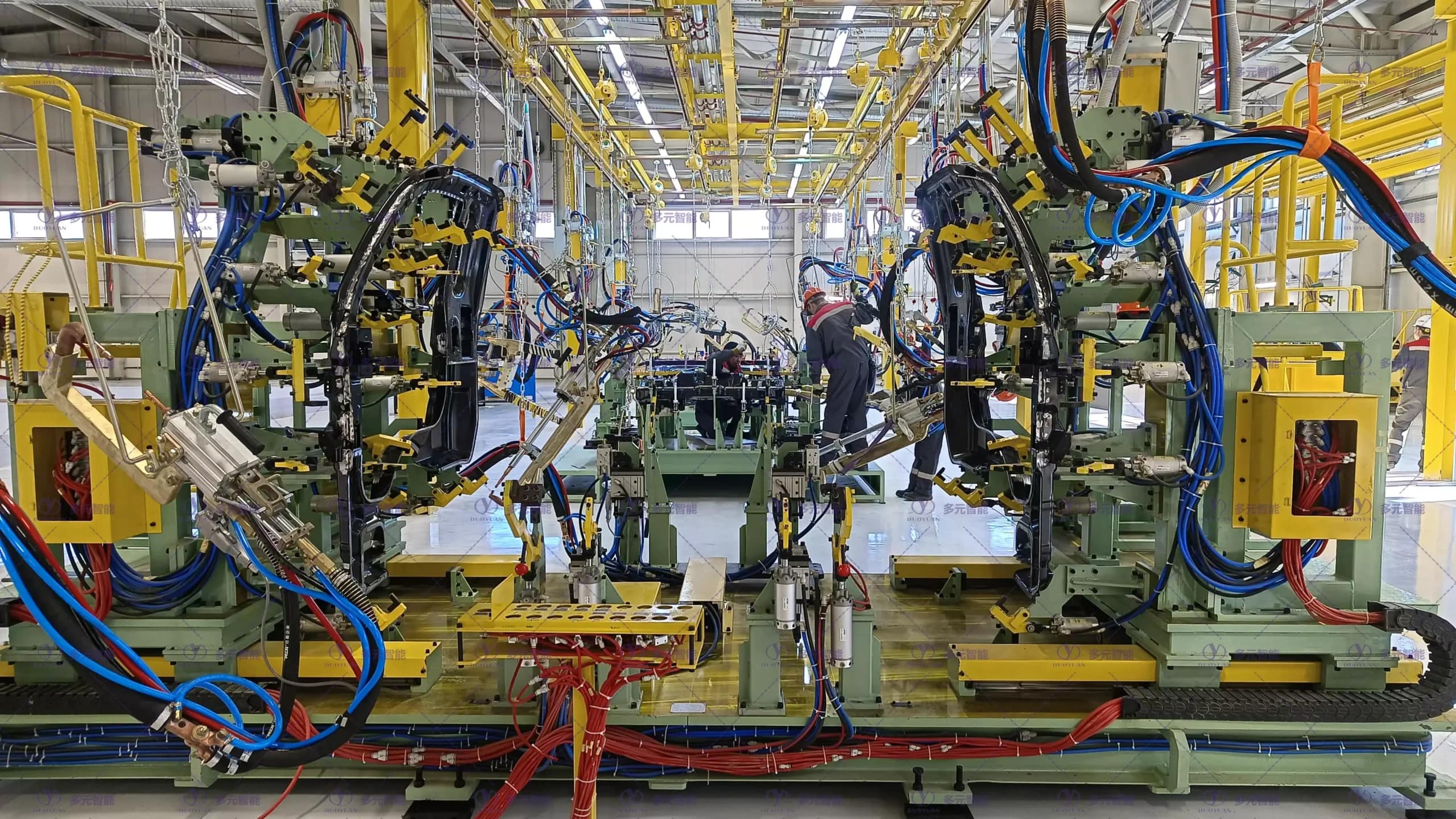
For CKD, the buyer should expect a wider engineering conversation. Body-in-white welding may need sub-assembly fixtures, main-line framing fixtures, robot stations, transfer equipment, geometry checks, and process documentation. The Wuling G200P BIW Welding Line shows how broad a body-shop scope can become: the project covered a main welding line, adjustment line, mechanical conveyor line, upper-body manual line, side-frame manual line, steel-structure design, manufacturing, installation, and acceptance; the package also included opengate flexible switching, AGV shuttle, automatic gluing, visual guidance, and fixture support.
For commercial-vehicle welding, the equipment scope can become even more dependent on vehicle structure and weld accessibility. DUOYUAN's CRRC Dump Truck Welding Production Line records automatic conveying, stable positioning, and more than 20 arc welding robots. That is not a CKD/SKD label by itself, but it is the kind of welding-system evidence a buyer should look for when a CKD supplier claims it can support body or cab process work.
For SKD, the scope may be lighter but must still be practical. Assembly fixtures, lifting devices, trolleys, platforms, EOL checks, and material routes decide whether the team can repeat the job. The Pakistan Zhongtong Bus Production Line gives a useful bus CKD reference because the public scope names Karachi CKD bus manufacturing, side panel hot stretching, skeleton assembly, roof panel stretching, welding trolley, axle lifting, and engine lifting. Those line-side details matter more than generic words such as "complete line."
Cost, localization, and hidden risk
The cheapest quote is often the one with the most exclusions. CKD quotations can look expensive because they include fixtures, integration, installation, trial production, training, and acceptance work. SKD quotations can look simple because the first process is lighter. But a missing crane, unplanned EOL area, unclear local supplier boundary, or weak spare-parts plan can erase that difference after the equipment ships.
The buyer should ask each supplier to separate base equipment, tooling, installation, commissioning, training, spare parts, software, EOL, local civil work, utilities, and acceptance documents. If the quote only lists equipment names without responsibility, it is not ready for board-level comparison. A supplier that has delivered both body-process and final-assembly projects can usually explain which parts must be bought now and which parts can wait for phase two.
Six citable facts from DUOYUAN project records
- DUOYUAN's KIA Kazakhstan light-truck CKD record describes a 2021-2022 launch window, more than eight months of on-site support, first-vehicle rollout on May 26, 2022, and planned annual capacity of 10,000 units.
- DUOYUAN's Qingdao Meijin hydrogen bus final assembly record describes a single-shift 1,000-bus program with body hangers, final assembly conveyor equipment, chassis high-position trolleys, tire assist manipulators, windshield assist arms, and second-level assembly platforms.
- DUOYUAN's CRRC dump-truck welding record includes automatic conveying, stable positioning, and more than 20 arc welding robots.
- DUOYUAN's Wuling G200P BIW record covers main welding, adjustment, mechanical conveyor, upper-body manual, side-frame manual, opengate flexible switching, AGV shuttle, automatic gluing, visual guidance, installation, and acceptance support.
- DUOYUAN's Pakistan Zhongtong bus record covers Karachi CKD bus manufacturing with side panel hot stretching, skeleton assembly, roof panel stretching, welding trolley, axle lifting, and engine lifting.
- DUOYUAN's Ethiopia Esway K60 SKD record covers bus SKD factory planning, assembly fixtures, final assembly, testing, and overseas launch support.
RFQ checklist before asking for a CKD or SKD quote
- Destination country, vehicle type, target annual output, local content target, and intended SOP date.
- Vehicle data, 3D or 2D drawings, body/cab dimensions, chassis data, module split, and packaging boundary.
- Existing workshop layout, column grid, floor condition, lifting equipment, compressed air, power, water, drainage, fire protection, and logistics doors.
- Process sections required from the supplier: welding, painting interface, final assembly, EOL, rain testing, lifting, storage, conveyors, fixtures, and robot cells.
- Local supplier boundary: civil work, utilities, steel structure, installation labor, customs, forklifts, cranes, operators, and maintenance staff.
- Acceptance evidence: FAT, packing inspection, installation check, dry run, trial assembly, quality gate, training signoff, spare-parts handover, and punch-list closeout.
Common mistakes
The first mistake is buying a kit format before defining the process scope. A buyer may say "SKD" but expect local welding, or say "CKD" while still outsourcing body process and painting. The quote then becomes impossible to compare.
The second mistake is separating equipment price from launch responsibility. Overseas projects need people on site, translation of technical documents, operator training, supplier coordination, and a way to close problems after the first trial vehicles. A low equipment price without commissioning responsibility can become the most expensive option.
The third mistake is hiding uncertainty. If annual volume, takt time, station count, local content, workshop utilities, or public project evidence is unknown, mark it as unknown. DUOYUAN keeps missing data visible in early planning because a clean open issue is easier to solve than a confident but wrong assumption.
FAQ
Is CKD always better than SKD?
No. CKD is better when the buyer wants deeper localization and can support more local process responsibility. SKD can be better for a faster first launch, smaller early volume, or a team that needs to build assembly capability step by step.
What information should be ready before asking DUOYUAN for a CKD or SKD line?
Prepare vehicle type, annual output, local content target, destination country, workshop layout, utility conditions, SOP date, required process sections, and the boundary between DUOYUAN, local suppliers, and the customer's own team.
Can one project start as SKD and later move toward CKD?
Yes, but the roadmap should be designed early. Layout, utilities, material flow, training, and acceptance standards should leave room for deeper localization; otherwise the second phase may require costly rework.
How should buyers compare CKD/SKD suppliers?
Compare verified project records, process scope, on-site commissioning responsibility, fixture and testing experience, training plan, spare-parts support, and acceptance evidence. A supplier should show how it will help the plant reach repeatable production, not only ship equipment.
Which DUOYUAN pages should I read next?
For bus projects, start with Bus and Coach Production Line, Pakistan Vehicle Assembly & CKD Plant Equipment, Pakistan Zhongtong Bus Production Line, and Ethiopia Esway K60 SKD Project. For truck or pickup projects, review Commercial Vehicle Production Line, KIA Kazakhstan Light Truck CKD Assembly Line, and CRRC Dump Truck Welding Production Line.